

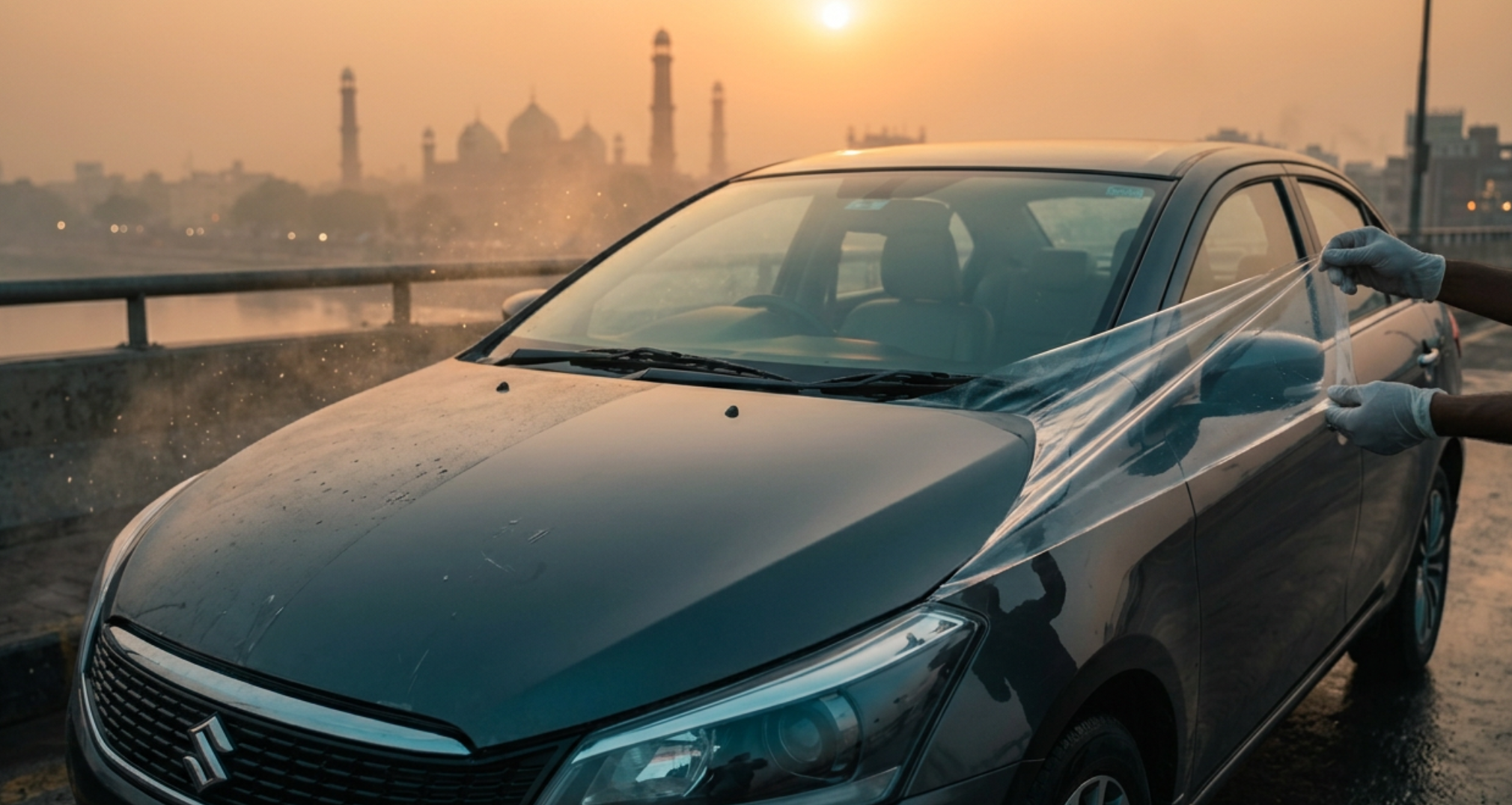
Every winter, Lahore disappears under a grey haze. Most of us check the AQI before leaving home and think about our lungs. Fewer people think about the car parked outside, which sits in that air day and night for months.
Smog does not only make a car look dirty. The fine particles, soot and moisture that settle on the bodywork can dull the clear coat, leave marks that do not wash off and, if the car is cleaned the wrong way, cause swirl marks. The good news is that you can protect car paint from smog with a few habits and the right layers of protection.
This guide explains how smog season damages paint, then covers every option in order: a safe washing routine, decontamination, wax and sealant, ceramic coating, car covers, parking choices and, as the strongest physical layer, paint protection film.
When Smog Season Hits Lahore and Where It Comes From
According to Arab News reporting on Punjab’s air quality, smog season in Pakistan begins in late October, peaks from November to January and can last into February. The same report links it to vehicle emissions, industrial pollution and the burning of crop residue across the province each winter.
Cold, still winter air traps these pollutants close to the ground. For your car, that means a steady layer of fine particles settling on the bonnet, roof and boot every night, for three to four months in a row. If you want the bigger picture on air quality numbers, our post on how Lahore’s AQI levels affect your car’s paint covers it in more detail.
How Smog Damages Car Paint
Smog damage is slow. You rarely see it in a single day, which is why many owners only notice it when the season ends and the paint looks flat. Four things do the harm:
- Fallout: fine particles from exhaust, industry and smoke land on horizontal panels and stick to the surface. Some of this fallout contains tiny metal particles that can bond to the clear coat.
- Acidic dew: overnight moisture mixes with the deposits on the paint. As the dew dries in the morning sun, it concentrates what it has picked up and can leave marks that etch into the clear coat if they sit for long.
- Soot: oily, black residue from exhaust smears easily and is hard to remove with water alone.
- Dust as an abrasive: the grit mixed into smog acts like fine sandpaper. Wiping it off dry, or washing with a dirty cloth, drags it across the paint and leaves swirl marks.
The result after a season is paint that feels rough to the touch, has lost its gloss and shows water spots or etch marks in direct light. The damage builds up, so the earlier you start protecting the paint, the less correction it will need later.
A Safe Washing Routine for Smog Season
Washing is your first line of defence, but a bad wash does as much harm as no wash. The aim is to lift the grit off the paint without rubbing it in.
- Rinse first. Use plenty of water to float off loose dust before anything touches the paint.
- Use two buckets. One bucket holds shampoo solution, the other holds clean water to rinse the mitt after each panel. This keeps grit out of your wash water.
- Choose a pH-neutral shampoo. A dedicated car wash shampoo cleans without stripping wax or sealant. Avoid dish soap and strong detergents.
- Wash with soft microfibre. Work from the roof down, in straight lines, and change to a clean side of the mitt often. Keep a stack of clean microfibre cleaning cloths for the job.
- Dry gently. Pat or drag a soft microfibre drying towel across the paint instead of letting water dry in the sun. Our guide on avoiding water spots after a car wash explains why this step matters.
Two more rules make a big difference. First, rinse fallout, dew marks and bird droppings off promptly rather than waiting for the weekend. Second, never dry-wipe dust off the car, even if you are in a hurry. A quick rinse is always safer than a quick wipe.
Decontaminate the Paint With an Iron Remover and Clay
Even a careful wash leaves some fallout bonded to the paint. You can feel it: run your fingertips over a clean bonnet inside a thin plastic bag, and a contaminated surface feels gritty rather than smooth.
Decontamination removes what washing cannot:
- Iron remover: spray it on the clean, cool paint, let it dwell for the time on the label and rinse it off. It dissolves bonded metal particles. Many iron removers change colour as they react, so you can see where the contamination was.
- Clay bar: after the iron remover, glide a clay bar over the paint with plenty of lubricant to lift remaining fallout, soot and tar. Fold the clay often so you always use a clean face.
Once or twice a smog season is usually enough for a car that is washed regularly. Clay can leave very light marring on soft paint, so finish with a protective layer straight after. For tougher deposits such as tar and tree sap, see our guide to removing road stains and contaminants.
Add a Layer: Wax, Sealant or Ceramic Coating
Bare clear coat is the easiest surface for smog to stick to. A protective layer on top gives the deposits something to sit on other than your paint, and makes the next wash easier.
Wax and Sealant
A good car wax or synthetic sealant adds gloss and water beading, and helps grime release during washing. It is affordable and easy to apply at home. The downside is lifespan: wax wears off in weeks, and sealant lasts a little longer. During smog season, plan to reapply more often than you would in summer.
Ceramic Coating
A ceramic coating bonds to the clear coat and lasts much longer than wax. It resists chemicals better, sheds water and makes smog residue easier to wash off. It is still a thin layer, though. It does not stop stone chips or deep scratches, and acidic deposits left on it for long can still mark it. A coating is best applied after decontamination and, ideally, after the paint has been corrected.
If you are weighing a coating against film, our comparison of PPF vs ceramic coating sets out where each one fits.
| Option | What It Does Well | Limits in Smog Season |
|---|---|---|
| Wax / sealant | Gloss, beading, easy washing | Wears off quickly; needs frequent reapplication |
| Ceramic coating | Chemical resistance, easier cleaning, longer life | Thin layer; no protection from chips; deposits still need washing off |
| Paint protection film | Thick physical layer; resists etching and chips; self-heals light swirls | Higher cost; quality depends on film and installer |

Car Covers and Parking Choices
Where and how the car sits overnight decides how much smog lands on it.
Use a Car Cover the Right Way
A breathable, well-fitted car top cover keeps most fallout and dew off the paint when the car is parked outside for long periods. Fit it only on a clean, dry car. A cover pulled over a dusty car rubs that grit into the paint every time the wind moves it. Fold it inside out when you take it off, so the dirty outer side never touches the paint, and wash the cover from time to time.
Park Smart
- Use a garage, carport or covered basement parking whenever you can.
- Avoid parking under trees, where bird droppings and sap add to the smog residue.
- At work, a covered or shaded bay reduces both fallout and the drying of dew in direct sun.
- If the car stands unused for days, check and rinse it before the deposits build up.
Many of these habits help in all cold-weather months, not just during smog. Our guide on how to protect your car’s paint in winter adds tips for fog and cold mornings.
Paint Protection Film: The Strongest Physical Layer
Washing, wax, coatings and covers all reduce smog damage. Paint protection film (PPF) goes a step further: it is a thick, clear urethane film applied over the paint, so fallout, dew and grit land on the film rather than the clear coat.
It is worth being clear about what PPF does and does not do:
- It resists etching better than bare clear coat. Acidic deposits are far less likely to reach the paint underneath. Bird droppings and smog residue should still be washed off promptly.
- Its self-healing top layer helps with light marks only. Heat from the sun or warm water can make light swirls and fine scratches in the film disappear. It does not heal acid etching or deep scratches.
- It stops what coatings cannot. PPF absorbs stone chips and road debris, which a ceramic coating does not.
- It still needs washing. PPF is not self-cleaning. Use the same gentle routine described above: pre-rinse, pH-neutral shampoo and microfibre.
Many owners combine the two, with PPF on the most exposed panels and a coating on top or on the rest of the car. If you are planning PPF for this winter, read our PPF buyer guide for Lahore smog season for coverage options, finishes and aftercare, and use the nine checks for choosing a PPF studio before you book with anyone.
At Detail by Autostore.pk, installation is carried out by factory-trained technicians certified by Flexishield USA, in a climate-controlled, dust-extracted bay with inspection lighting. We offer Flexishield, Nano Pro and 3M films in gloss, matte and satin finishes, with up to a 10-year manufacturer-backed warranty depending on the film. You can see the studio on our virtual tour or browse all our PPF, window tint and ceramic coating services.
Your Smog Season Paint Care Checklist
- Before the season: wash, decontaminate and apply wax, sealant, coating or PPF.
- Every week: a gentle two-bucket wash with pH-neutral shampoo and clean microfibre.
- Every day if needed: rinse off fallout, dew marks and bird droppings with water.
- Never: dry-wipe dust or put a cover on a dirty car.
- Mid-season: check the paint by touch and decontaminate again if it feels rough.
- After the season: inspect in good light and book a correction if marks remain.
Frequently Asked Questions About Protecting Car Paint From Smog
Smog season will come back every winter, but the damage to your paint does not have to. If you would like advice on PPF or coating for your car, book an appointment at our Gulberg studio for a free consultation. Call 0321 2111 406 or WhatsApp 0302 2111 406.
One Comment