

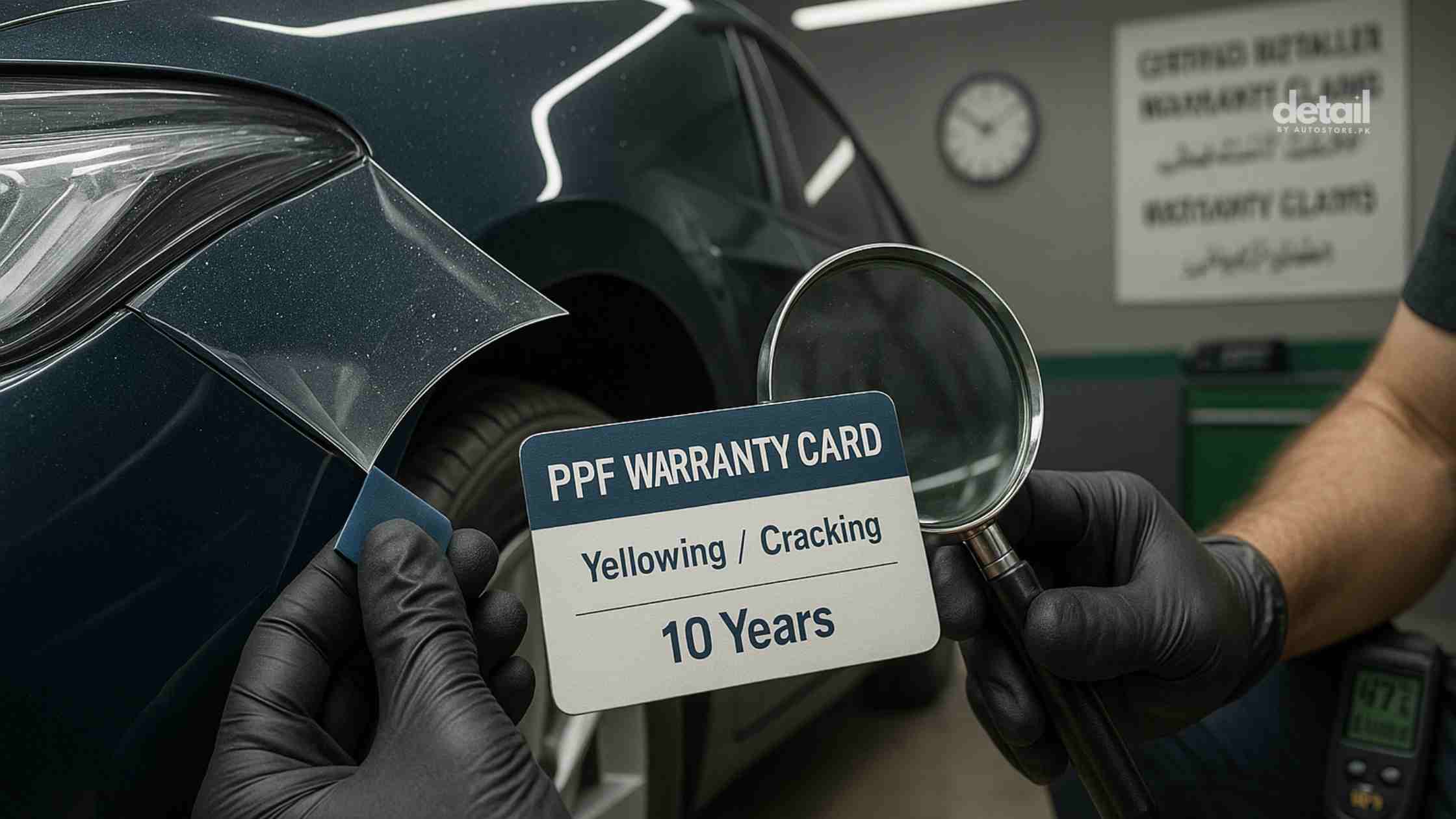
You’ve just invested a significant sum in Paint Protection Film (PPF), and the installer hands you a card promising a 5, 7, or even 10-year warranty. You feel secure. But what happens when a corner starts to lift, or the film looks hazy? That shiny new film promises a decade of protection—until a tiny clause in the fine print flips the script. This is your guide to the PPF warranty terms explained for Pakistani car owners, so you can decode the jargon before you ever need to make a claim.
Why PPF Warranties Matter More in Pakistan
A PPF warranty isn’t just a piece of paper; it’s your shield against conditions unique to our country. Your car endures a Motorway M-2 sunbake, where panel temperatures can reach a blistering 48°C, putting immense stress on the film’s adhesive. It faces clouds of fine, abrasive dust from nearby brick kilns and construction sites. Add the risk of counterfeit car shampoos containing harsh chemicals, and you have a perfect storm in which a robust, clearly understood warranty is not a luxury—it’s essential for peace of mind.
Warranty Terms at a Glance
|
Clause |
Typical Coverage | Duration | Pakistan-Specific Watch-Out |
|
Yellowing |
The film is turning a noticeable yellow shade due to UV exposure. | 5-12 Years | Crucial with our high UV index. Ensure it’s covered. |
|
Cracking/Bubbling |
Film cracking, blistering, or bubbling not caused by impact. | 5-12 Years |
Extreme heat can accelerate this; look for “blistering” specifically. |
| Delamination | The top coat of the film is separating from the base layer. | 5-12 Years |
Harsh chemicals can cause it. Stick to pH-neutral shampoos. |
| Edge Lifting | Often, an installer’s workmanship is the issue, but sometimes it is not. | 1-2 Years (Installer) |
High-pressure washing is the #1 cause of rejection. Know the rules! |
Unpacking What Your PPF Warranty Really Covers
When a reputable brand like XPEL or FlexiShield offers a 10-year warranty, it stands behind the chemical stability of its product. This is your guarantee against manufacturing defects. The core protections you should look for are clear and specific. Coverage typically includes yellowing from UV radiation, cracking under thermal stress, and staining or hazing from environmental sources (excluding harsh chemicals).
It also covers adhesive failure, in which the film loses its bond to the paint for no apparent reason, and delamination, in which the film’s layers separate. For modern films, a key promise is the loss of self-healing properties; if light scratches no longer disappear with heat, it could be a valid claim. This coverage ensures the film itself won’t fail, keeping your paint safe from GT-Road gravel splash and daily wear.
Protect Your Coverage: What Instantly Voids Your Warranty
This is the fine print that matters most. A manufacturer’s warranty can be voided in a heartbeat by improper care or modification. The most common mistake is misusing a pressure washer. Getting the nozzle closer than the recommended 30 cm (1 foot) or aiming it directly at an edge can force water under the surface, causing it to lift. This is almost always grounds for rejection of the claim.
Other warranty killers include attempting a DIY edge trim on a piece that has lifted slightly, using acidic or abrasive cleaners (like wheel cleaners) on the film, or applying polishes with harsh solvents. Even installing aftermarket headlights that run hotter than factory spec can generate enough heat to damage the bumper film, voiding coverage for that panel. Your warranty is a partnership: the manufacturer guarantees the film, but you must ensure it is correctly cared for.
Brand-to-Brand Warranty Showdown
|
Feature |
XPEL | FlexiShield | SunTek | Local Comment |
|
Standard Duration |
10 Years | 5 to 12 Years (Varies by product) | 5 to 10 Years (Varies by product) | Longer is better, but ensure the installer is established enough to honour it. |
|
Transferable? |
Yes (Typically) | Often, with registration | Varies, check policy |
A massive plus for resale value in Pakistan’s active used car market. |
| Labour Coverage | Often covered if installed by a certified installer. | Varies; may be the installer’s responsibility. | Varies; often installer-dependent. |
Crucial! A new film roll is useless if you have to pay for the 8-hour re-install. |
| Claim Process | Centralised, via certified installer network. | Handled through the regional distributor/installer. | Handled through the installer. |
A clear, documented process from a brand like XPEL offers more peace of mind. |
Installer vs. Your Responsibilities: A Two-Way Street
A successful warranty is a shared responsibility. The installer’s duties are critical. They must be certified by the film’s manufacturer, use official software and plotters for precise patterns (no risky hand-cutting on your paint!), and prepare the surface flawlessly. After installation, they must inform you of the 30-day cure time, during which the film is vulnerable and shouldn’t be washed. A professional installer will provide a care kit and document the warranty with your car’s VIN.
Your responsibilities begin the moment you drive away. You must adhere to the washing guidelines (no high-pressure jets on edges!), use only recommended pH-neutral shampoos, and avoid abrasive polishes or unapproved chemicals. Keeping your original invoice and warranty card safe is also your job. Neglecting these simple care steps can give the manufacturer a valid reason to deny a future claim.
Follow This Step-by-Step PPF Warranty Claim Process
If you notice an issue like bubbling or yellowing, don’t panic. Follow a straightforward process to ensure your claim is handled smoothly.
- Stop and Document: The moment you see a potential defect, stop using any products on that area. Take clear, well-lit, and dated photos of the issue from multiple angles.
- Locate Your Paperwork: Find your original installation invoice and the warranty card or registration number. These are non-negotiable.
- Contact Your Original Installer: The claim process always starts with the certified installer who did the work. Do not go to another shop.
- Schedule an Inspection: Book an appointment for them to inspect the failure physically. A reputable shop will have a dedicated process for this.
- Submit the Claim: The installer will typically file the claim with the manufacturer (e.g., XPEL, FlexiShield) on your behalf, submitting your photos and invoice details.
- Await Factory Review: The manufacturer’s warranty department will review the evidence to determine if the failure is due to a product defect or an external factor (like improper care).
- Receive the Verdict: The installer will inform you of the manufacturer’s decision. This can take a few days to a couple of weeks.
- Schedule Replacement: If approved, the manufacturer will ship a replacement film, and you will schedule a time with your installer for the removal and re-application. Be sure to clarify whether labour costs are covered.
Real-World Case Study: Edge-Lift on a 2-Year-Old Sportage
A client with a Kia Sportage noticed that the PPF edge on his driver’s side door was lifting after 2 years. He feared his claim would be denied. However, he had followed the rules. He had his original invoice from a certified installer and had only ever hand-washed the car, avoiding the edges with any pressure rinse. He took photos and contacted the original installer.
The installer inspected the panel and confirmed no signs of pressure-washer damage. They filed the claim, noting their own installation records. The manufacturer approved the claim as a potential adhesive defect. The owner received a free replacement of the door panel film, including labour, because he had a clear record of compliance and worked through the official channel.
Myths vs. Facts About PPF Warranties
|
The Claim |
The Reality | The Takeaway for You |
|
“A 10-year warranty means the film will look brand new for 10 years.” |
False. It warrants against specific failures, such as yellowing/cracking, not against normal wear and tear, such as scratches or scuffs. | Manage expectations. The film is there to be sacrificed to protect the paint underneath. |
| “Any detailer can handle a warranty claim.” | False. Only the original, certified installer can process a manufacturer’s warranty claim. |
Choosing a well-established, certified installer is as important as choosing a good film brand. |
| “The warranty covers rock chips.” | False. The warranty covers film defects. It does NOT cover damage from impact, such as rock chips, scratches, or accidents. |
The film’s job is to absorb the impact, so your paint doesn’t chip. The film did its job. |
FAQs: PPF Warranty Terms Explained
1. Does the salty sea-air haze in Karachi count as a ‘chemical stain’ that could void my warranty?
Generally, no. High-quality PPF is designed to resist environmental fallout, including salt air. However, if you let the salt build up for weeks without washing, the concentrated deposits could cause issues. Regular washing as per the care guidelines is your best defence and helps protect your warranty.
2. Will applying a ceramic coating on top of my PPF void the warranty?
This is a critical question. Some film manufacturers approve and even sell their own “PPF-specific” ceramic coatings. Using a non-approved coating could potentially void the film warranty. Always check with your installer or the film’s official documentation before applying anything over the PPF.
3. I had my car wrapped with XPEL in Dubai. Can I make a warranty claim in Pakistan?
Yes, in most cases. Major international brands like XPEL have a global warranty network. As long as you go to a certified XPEL installer in Pakistan and have your original proof of purchase and warranty registration from Dubai, they should be able to process your claim. This is a major benefit of choosing a global brand.
Is Your Warranty Secure?
Don’t wait for a problem to find out if your PPF is properly protected. Let our experts give your car a complimentary ‘Warranty Health Check’.
We’ll professionally inspect your film’s edges, test its gloss and hydrophobic properties, and give you a clear status report—absolutely free, no strings attached.
Conclusion: Drive with Confidence
Your PPF warranty is more than just a marketing promise; it’s a technical contract that protects your investment. By understanding what’s covered, what’s excluded, and your responsibilities, you transform that fine print from a source of anxiety into a source of confidence. Understand the clauses today so you can drive chip-free for the next decade, fully shielded from road hazards and without the fear of hidden traps.