

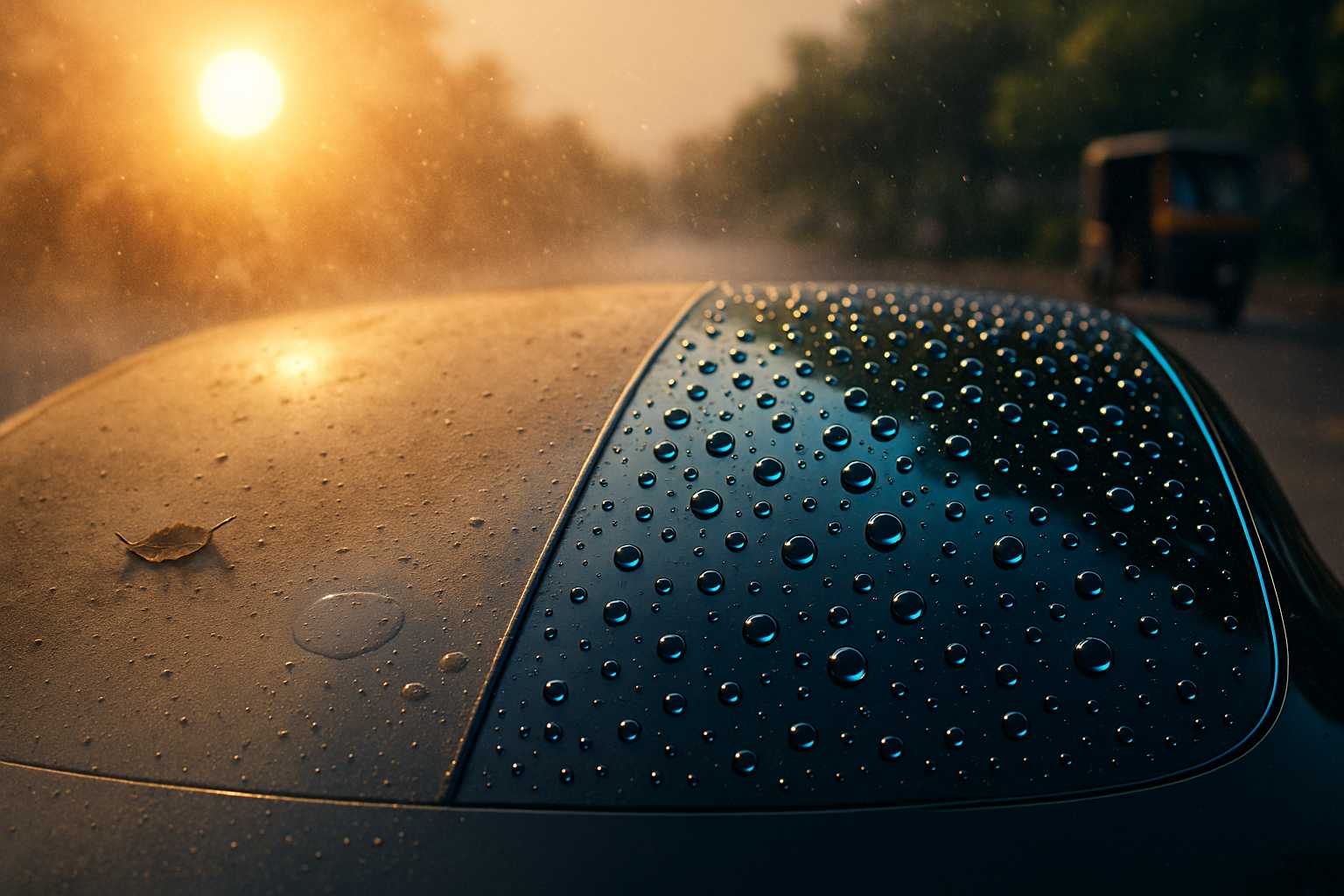
You’ve just had your car ceramic coated. The paint is dripping with gloss, and during the first rain, water beads up and races off the panels like marbles on glass. It’s automotive magic. But as you park your car under the blazing Lahore sun, a critical question arises: how long does ceramic coating last in Lahore’s extreme weather conditions? Will those perfect beads be gone by next season?
The answer isn’t a single number. A coating’s lifespan is a battle between its chemical resilience and our city’s brutal environment. But don’t worry—beads today don’t have to mean a dull finish tomorrow. Not if you understand the “Lahore clock” on ceramic coatings and how to slow it down.
How a Ceramic Coating Fights the Elements
First, let’s understand your paint’s new bodyguard. A true ceramic coating is a liquid polymer containing a high concentration of Silicon Dioxide (SiO₂). When applied, it forms a chemical bond with your car’s clear coat, creating a semi-permanent, glass-like layer of protection.
This hardened shell does three critical jobs. Its 9H hardness helps resist minor scratches. Its chemical structure provides a barrier against UV rays and acid rain. And its extreme hydrophobicity creates a slick, non-stick surface that repels water and dirt. In essence, these nanoparticles form a shield against environmental stress by forming a cohesive structure.
Key Factors That Determine Coating Longevity
Before we even get to the weather, a coating’s ultimate lifespan is decided by five key factors:
- Product Quality: A cheap, low-SiO₂ “ceramic spray” is not the same as a professional-grade, multi-year coating. The quality and concentration of the chemistry matter most.
- Paint Preparation: A coating can only bond to pure, clean paint. A rushed job that skips proper decontamination and paint correction will lead to premature failure.
- Installation Skill: Applying a ceramic coating is a science. It requires a controlled environment and precise technique to ensure proper bonding and a flawless finish.
- Aftercare & Maintenance: This is the biggest factor you control. The way you wash and care for the coating will directly impact its longevity.
- Driving & Parking Conditions: A car that’s garage-kept and driven 5,000 km a year will see its coating last far longer than a daily driver parked outside on MM Alam road.
The Lahore-Specific Stress Test: A Coating’s Worst Enemies
Lahore’s environment is uniquely harsh. A ceramic coating here endures a relentless assault from four major threats:
- Extreme Heat & UV: In summer, a car parked outside can reach surface temperatures of 65-70°C. This intense heat, combined with a UV Index of 11+, constantly works to break down the coating’s polymer structure.
- Monsoon Humidity: The 80%+ humidity during monsoon season, especially near the Ravi River, can create challenges. It slows the final curing process and, when combined with dust, can lead to stubborn water spots if the car isn’t dried properly.
- Abrasive Dust: Lahore experiences over 120 dusty days annually. This fine, gritty dust from Ferozepur Road traffic and construction sites is highly abrasive. An improper wash (like using a dry cloth or a dirty sponge) turns this dust into sandpaper, physically wearing down the coating.
- Industrial Fallout & Acid Rain: The city’s air contains pollutants that mix with rain to form a mild acid. This acidic rain sits on your car and tries to etch into the surface, constantly testing the coating’s chemical resistance.
Expected Ceramic Coating Lifespan in Lahore
So, what can you realistically expect? It depends on the tier of coating you choose and your commitment to maintenance.
|
Coating Tier |
Manufacturer’s Claim* | Realistic Life in Lahore* |
Main Threat in Lahore |
|
Entry-Level (1-2 Year) |
Up to 24 months | 12 – 18 months |
Abrasion: A thin layer wears down faster due to dust and washing. |
|
Pro-Grade (3-5 Year) |
Up to 60 months | 30 – 48 months |
Neglect: Failure to maintain it properly is the primary cause of early fading. |
|
Graphene-Infused (5+ Year) |
7 years or more | 48 – 60+ months |
Chemical Damage: Can be damaged by harsh, high-pH cleaners or improper decontamination. |
Spot a Fading Coating Early: The Red Flags
How do you know your coating is losing its power? Watch for these signs:
- Flat Water Behavior: Instead of tight, uniform beads, water starts to form large, slow-moving pools (“sheeting”).
- Increased Dirt Cling: The car becomes dirtier faster and is more difficult to clean. The “self-cleaning” effect is noticeably reduced.
- Loss of Slickness: The paint no longer feels silky smooth to the touch (when clean).
- Reduced Gloss: The deep, wet shine begins to look a little duller than you remember.
Maintenance Schedule to Reach Maximum Lifespan
Want to hit the upper end of those lifespan estimates? Follow this simple schedule.
- The Two-Bucket Wash: Every 1-2 weeks, wash your car using the two-bucket method to prevent scratches.
- Use pH-Neutral Shampoo: Harsh, high-pH soaps can strip the top layer of your coating. Stick to dedicated, gentle car shampoos.
- Gentle Drying: Use a plush microfiber drying towel. Pat the car dry or use a leaf blower to minimize contact with the surface.
- Avoid “Service Station” Washes: Most local service stations use harsh chemicals and dirty rags that can damage your coating.
- Apply a SiO₂ Topper: Every 2-3 months, use a quality silica-based spray sealant. This is a 15-minute job that revitalizes the hydrophobicity and adds a sacrificial layer of protection.
- Park Smart: Whenever possible, park in the shade or a basement to protect the coating from the worst of the sun’s UV and heat.
- Annual Decontamination: Once a year, have a professional perform a chemical decontamination (iron and tar remover) to deep clean the coating’s pores.
- Annual Pro Inspection & Top-Up: A yearly visit to your detailer for an inspection and application of a concentrated professional top-coat is the single best way to ensure maximum longevity.
Myths vs. Facts About Coating Durability
|
The Claim |
The Reality |
The Takeaway for You |
|
A 5-year coating lasts 5 years, regardless of the circumstances. |
A 5-year rating is a lab-tested maximum. Real-world life depends entirely on maintenance and environment. |
You must follow the aftercare plan to approach the claimed lifespan. |
| Ceramic coatings are scratch-proof. | They are scratch-resistant, not scratch-proof. They help prevent light swirls from washing, but will not stop a key scratch or rock chip. |
You still need to be careful. The coating is a shield, not invincible armor. |
| You never have to wash a car with a coating. | False. The coating makes washing much easier, but it still needs regular cleaning to remove contaminants that can clog and degrade it. |
Wash your car regularly to keep the coating healthy and performing its best. |
DIY Boosters vs. Professional Top-Ups
There’s a big difference between the products you can use at home and what a pro applies during an annual service.
- DIY Boosters (Silica Sprays): These are fantastic maintenance products. You spray them on after a wash, and they act like a quick wax, restoring slickness and water-beading for a few weeks or months. They are a sacrificial layer on top of your main coating.
- Professional Top-Coats: These are concentrated formulas, often a lighter version of the primary coating itself. They are applied after a thorough chemical decontamination and are designed to fill in microscopic pores and reinforce the original coating, significantly extending its functional life.
Cost of Re-Coating vs. Proper Maintenance
|
Action |
Cost (Approx. PKR) | Frequency |
5-Year Total |
| Neglect & Full Re-Coat | 60,000+ | Every 2-3 years |
120,000+ |
| Proper Annual Maintenance | 8,000 – 12,000 | Once a year |
40,000 – 60,000 |
FAQs: How Long Does a Ceramic Coating Last in Lahore’s Weather?
1. Will a graphene coating last longer than ceramic in Lahore?
Graphene coatings are marketed as having better heat dissipation and water-spot resistance. In theory, this makes them better suited for Lahore’s climate. In real-world testing, a high-quality graphene coating often exhibits slightly better longevity and durability than a comparable ceramic; however, proper maintenance remains the most critical factor for both.
2. Does parking in the shade really double the coating’s life?
It won’t literally double it, but it makes a massive difference. Reducing exposure to direct UV and extreme heat is the single biggest environmental factor you can control. A car parked in a basement will easily outlast one parked on the street by a year or more.
3. What happens if I use a clay bar on my coated car?
You should avoid it. A clay bar is a mechanical abrasive. While it’s great for cleaning bare paint, it can abrade and wear down your ceramic coating, reducing its thickness and lifespan. For a coated car, always opt for chemical decontamination (iron and tar removers) first.
Conclusion: Your Shield Against the City
A ceramic coating is your paint’s best defense against the extremes of Lahore. While it isn’t a “set it and forget it” solution, its lifespan is largely in your hands. Treat the coating right with a simple but consistent maintenance routine, and it will shrug off Lahore’s punishing sun and dust—keeping your paint party-ready and dripping with gloss for years, not just months.
Is your coating looking tired? I’m not sure if it’s still working. Book a free hydrophobic health check at our Gulberg studio. We’ll assess its condition and give you 10% off your first annual maintenance top-up.
Call: +92-321-2111-406 WhatsApp: 0302 2111 406
For More car detailing services, visit Detail By Autostore.pk.