

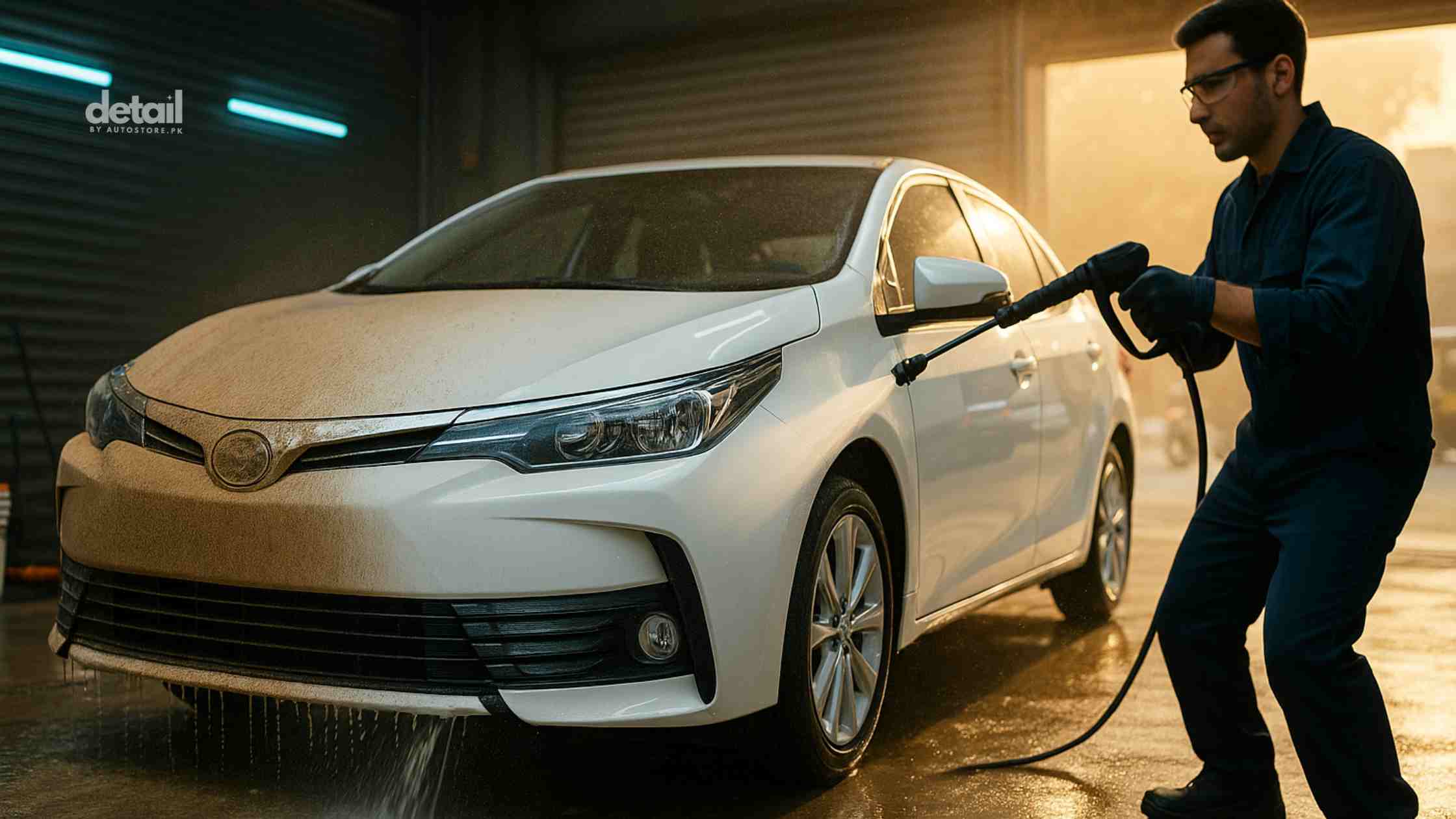
Park your car for just five minutes on Ferozepur Road, and it happens: a fine, gritty layer of dust settles over your prized vehicle. On normal paint, it’s annoying. On your glossy, expensive Paint Protection Film (PPF), it’s a potential disaster. That dust isn’t just dirt; it’s a cocktail of abrasive particles waiting to scratch your film. This is why proper PPF maintenance during Lahore dust is not just a cleaning chore—it’s a critical strategy to protect your investment.
Forget everything you know about a quick wipe-down at the petrol pump. This guide is your new rulebook for keeping your clear bra glossy, self-healing, and grit-free, no matter how bad the MM Alam flyover haze gets.
Why Lahore Dust is Your Film’s Worst Enemy
The dust in Lahore is uniquely aggressive. It’s a mix of:
- Silica Grit: Fine particles of sand and construction debris from the endless Ring-Road projects. This micro-grit claws at your clear bra every time it’s wiped improperly.
- Brick-Kiln Soot: Oily, industrial particles that can bond to the film’s surface.
- Abrasive Particulates (PM2.5): Microscopic pollutants that work their way into the film’s pores.
When this layer gets baked onto your car in our 45°C summer heat, it becomes a sheet of sandpaper. A simple dry wipe will drag these sharp particles across your film, creating a web of fine scratches and dulling the finish, potentially damaging the self-healing top coat.
Daily vs. Weekly Care: An At-a-Glance Plan
|
Task |
Frequency | Time Needed | Key Benefit |
|
Touch-Free Rinse |
Every 2-3 days (if very dusty) | 5 minutes | Removes the heavy top layer of dust without any physical contact. |
|
Proper Two-Bucket Wash |
Once a week | 45-60 minutes |
Safely cleans the film, preserving its gloss and self-healing properties. |
| Edge Inspection | Once a month | 2 minutes |
Catches potential edge-lift early before it becomes a major problem. |
| Apply Topper/Sealant | Every 3-6 months | 20 minutes |
Boosts hydrophobicity, making it harder for dust to stick. |
Rinse Dust Off Before You Ever Touch the Film
This is the golden rule of PPF maintenance during Lahore dust. Never, ever start scrubbing or wiping a dry, dusty car. You must remove as much grit as possible without physical contact. This is your touch-free first strike.
- Air Rinse (Optional but ideal): If you have a leaf blower, use it to blow off the loose top layer of dust. This is the safest method of all.
- Low-Pressure Water Rinse: Thoroughly rinse the entire vehicle with a gentle spray of water. Start from the top and work your way down, letting gravity help you. The goal is to let the water sheet over the panels and carry the dust away.
- Snow Foam Pre-Soak: This is a game-changer. Use a foam cannon with a quality pH-neutral shampoo to cover the car in a thick layer of suds. Let it dwell for 5-10 minutes (but not dry). This foam encapsulates the remaining dirt particles, lifting them from the surface so they can be rinsed away safely.
The Two-Bucket Wash Method, Tweaked for PPF
After your touch-free pre-wash, it’s time for a safe contact wash.
- Prepare Your Buckets: You need two buckets, both with Grit Guards at the bottom. One is for your soapy water (30 ml of pH-neutral shampoo to every 10 L of water), and the other is for clean rinse water.
- Use a High-Quality Wash Mitt: A plush, 400+ gsm microfiber wash mitt is essential. It has deep fibers that pull grit away from the surface, unlike a simple sponge.
- Wash Top-Down: Start with the roof. Dunk your mitt in the soap bucket, gently wash a small section (e.g., half the roof), then immediately rinse the mitt thoroughly in your clean water bucket before returning to the soap.
- Gentle, Straight-Line Motions: Don’t scrub in circles. Use light pressure and straight-line passes. Let the suds do the work.
- Rinse Frequently: The “one pass, then rinse mitt” discipline is key to preventing scratches.
- The Final Rinse: After washing all panels, perform a final “sheet rinse.” Remove the nozzle from your hose and let a gentle stream of water flow over the panels at a 45° angle. This causes the water to sheet off, leaving fewer droplets behind and reducing water spots.
- Safe Drying: The best way to dry is with a leaf blower or a dedicated car dryer. If using a towel, use a large, high-quality microfiber drying towel. Lay it flat on the surface and gently pat or pull it off. Never rub vigorously.
- Dry the Crevices: Use compressed air or the corner of a towel to blow water out of panel gaps, mirror housings, and around emblems. This prevents the dusty drip lines that appear later.
Boost Your Defenses: Hydrophobic Toppers
A “hydrophobic” surface is one that repels water. For PPF, this also means it’s slicker and harder for dust to cling to. Applying a topper is a crucial part of PPF maintenance during Lahore dust.
|
Product Type |
Durability | Dust-Shedding Benefit | Lahore Tip |
|
Spray Sealant (SiO₂ infused) |
2-4 months | Good. Creates a slick surface that helps dust blow off more easily. | Easy to apply after a wash. A great entry-level option. |
| Ceramic Spray Coating | 6-12 months | Excellent. Forms a harder, slicker layer, significantly reducing dust adhesion. |
The sweet spot for performance and ease of application. |
| Full Ceramic Coating (for PPF) | 2+ years | Superior. The ultimate in slickness and chemical resistance. |
Best applied by a professional right after the film is installed. |
Pro Tips & Common Mistakes
✅ DO use a dedicated iron fallout remover every 6 months to decontaminate the film. It will dissolve embedded iron particles, seen as tiny orange specks.
✅ DO blow-dry crevices and panel gaps to prevent the ugly, dusty drip lines that form after a wash.
✅ DO keep your pressure washer nozzle at least 30-40 cm away from the film, especially near edges.
🚫 DON’T ever let the “service station wala” dry-wipe your dusty car with a dirty cloth. This is the #1 cause of swirls on PPF.
🚫 DON’T use a traditional clay bar. Use a synthetic “clay mitt” or “clay towel” with plenty of lubrication, as they are gentler on the film’s top coat.
🚫 DON’T use harsh, alkaline soaps or degreasers. Stick to pH-neutral shampoos to protect the film and its warranty.
FAQs: Guide to PPF Maintenance During Lahore Dust
1. Is it ever safe to use a “waterless wash” spray on a dusty PPF?
It’s extremely risky. A waterless wash is only safe for very light dust that you can barely see. For the visible layer of gritty dust we get in Lahore, a waterless wash will likely act like liquid sandpaper, grinding the grit into your film. A touch-free rinse is always the safer first step.
2. How often should I do an iron decontamination on my film in Lahore?
Given our air quality and the amount of brake dust on the roads, a chemical decontamination with an iron remover every 6 months is a good routine. You’ll know it’s time when you see tiny orange or black specks on your film (especially on white cars) that don’t come off with a normal wash.
3. Will applying a ceramic topcoat void my PPF’s warranty?
No, not if you use a coating specifically designed for PPF. Major film manufacturers like FlexiShield and XPEL approve of and even encourage the use of compatible ceramic coatings. They enhance the film’s performance. Using an incompatible or improperly applied coating, however, could be an issue, so it’s best to have it done professionally.
Tired of Fighting the Dust Alone?
Let the pros handle the dirty work. Our Dust-Defense Maintenance Wash uses the exact touch-free and safe-contact methods described here to guarantee a flawless, scratch-free clean every time.
Book your first maintenance wash this month and receive a free professional edge inspection and a complimentary SiO₂ topper application!
Conclusion: Protect Your Protection
Your PPF is a significant investment in your car’s beauty and value. Don’t let improper cleaning destroy it. By adopting a smart, touch-free-first approach, you can master PPF maintenance during Lahore dust. Keep the film armored, the self-healing layer healthy, and the paint underneath party-ready—no matter how thick the next dust cloud rolls in.