

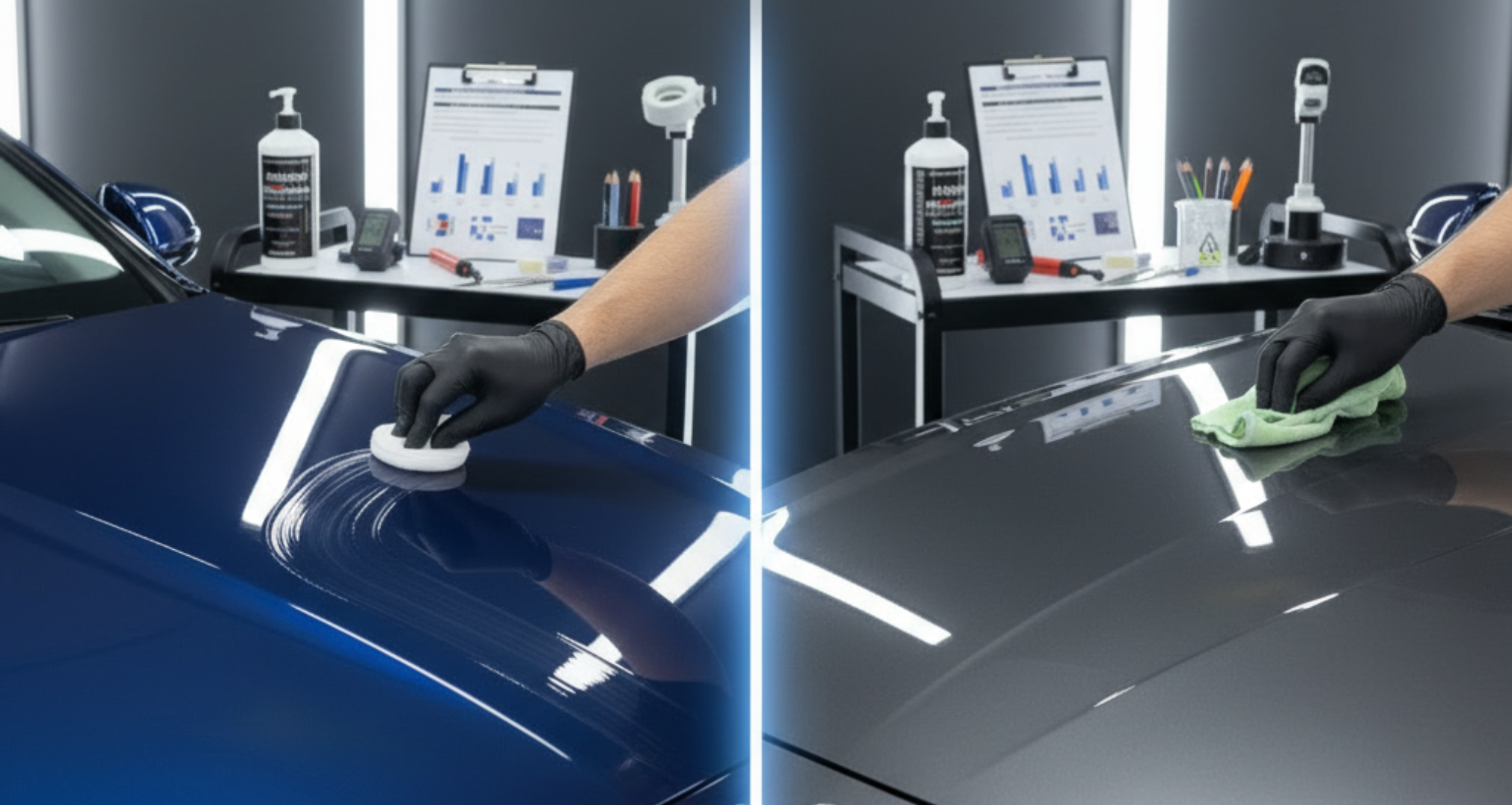
Your car sits under 45-degree Lahore sun six months straight. It eats dust on Ring Road stop-and-go, monsoon rain in September, and sits through stop-and-go traffic that barely lets the alternator catch its breath. You didn’t buy it to watch the paint fade in three years, and you’re finally ready to protect it properly. But now there’s a choice: ceramic or graphene coating? Every detailing shop has a different opinion when it comes to graphene coating vs ceramic coating. One says ceramic is the safest choice because it has been around for years. The next guy says graphene is newer, so it has to be better. Then you scroll online and see people claiming their coating lasted five years, while your cousin’s ceramic started getting water spots in six months. Honestly, it gets confusing fast.
Prices are all over the map and no one’s being honest about what actually works here.
This guide skips the BS. We’re breaking down what’s in these things, how they do in our heat and humidity, what actual testing says about durability, and if graphene’s worth paying extra for when you’re just driving around Gulberg, not storing some Porsche in a climate-controlled garage.
What Ceramic Coating Actually Is
Ceramic coating is basically a liquid protective layer made with silicon dioxide—think of it as highly refined sand. Unlike wax, it does not just sit on top of the paint and wash away after a few weeks. Once applied, it bonds with your car’s clear coat at the microscopic level, creating a tougher layer that lasts much longer.
The main benefit is that water beads up and rolls off instead of sitting there collecting dust. It also blocks most UV rays, which is huge in Pakistan where sun damage kills paint faster than anything else. A quality ceramic creates a barrier against bird droppings, tree sap, and the kind of acidic contamination you get from driving through Karachi’stondustrial zones.
Professional-grade ceramic coatings cure to a 9H hardness rating on the pencil scale, the same test used for smartphone screens. It’s not bulletproof, but it’s significantly harder than the factory finish on most cars sold here. The coating thickness ranges from two to five microns, which is thin enough that you can’t see or feel it, but thick enough to absorb light scratches and contamination before they reach your actual paint.
Water spotting is another mineral-rich, brutal, ceramic-coated issue in Islamabad. When mineral-rich water sits on a coated surface and evaporates, those minerals can etch into the coating. It’s not permanent damage to your paint, but removing those spots requires polishing, which means you’re cutting into the coating’s thickness and shortening its life.
Ceramic coatings here last six months if you’re using cheap spray stuff, up to three years if you get it done properly at a studio. How long it goes depends on how you wash it, what soap you use, and how much sun and dirt it sees.
Here’s the key bit that most marketing skips over. Graphene coatings are not a completely different technology from ceramic. They’re ceramic coatings with graphene oxide blended into the silicon dioxide base. You’re grapheneting that SiO2 intended to address heavy lifting. Graphene is an additive formulation that improves specific weaknesses in traditional ceramic formulations; anti-static claims include higher thermal conductivity, anti-static properties, greater flexibility, and reduced water spotting. Let’s go through what those actually mean in practice.
Cost Breakdown: What You’re Really Paying
Professional Ceramic Coating Prices
For a small hatchback, a basic ceramic coating job can start from around Rs 8,000 at a budget detailing studio. If you have a sedan or crossover, expect to spend somewhere between Rs 12,000 and Rs 20,000 for a decent mid-range job. SUVs, luxury cars, or premium packages with multi-year warranties can easily cost Rs 30,000–50,000.
Why Graphene Costs More
Graphene coating usually costs 20–40% more than ceramic coating. So if ceramic is Rs 12,000, graphene may land around Rs 15,000–18,000. Some of that extra price makes sense because graphene-based materials cost more to produce. But let’s be honest, a bit of it is just the “new tech” hype too—shops know graphene sounds fancy, so they price it like it’s the final boss of car protection.
DIY Coating Costs
If you want to do it yourself, ceramic spray coatings are much cheaper. You can find them for around Rs 1,500–5,000 per bottle, and one bottle usually covers one or two cars depending on the size. In Pakistani conditions, expect them to last about 3 to 6 months.
Graphene sprays are usually priced between Rs 3,000 and Rs 7,000. They may claim to last six to twelve months, but real-world results are often less impressive—especially if the car stays outside, gets washed frequently, or is exposed to heavy dust and heat.
Cost Per Year Is the Real Game
Do not just look at the upfront price. Think about what you are paying per year.
- A Rs 15,000 ceramic coating that lasts two years works out to Rs 7,500 per year.
- A Rs 20,000 graphene coating that lasts three years comes to about Rs 6,667 per year, which is actually better value.
- But if that same graphene coating only lasts 18 months, you are paying around Rs 13,333 per year—not exactly a win.
So yeah, graphene is only worth the extra money if it genuinely lasts longer.
Professional vs DIY: What’s the Difference?
A proper detailing studio does more than apply the coating. They usually wash, decontaminate, clay the paint, and sometimes do light paint correction to remove swirls before applying anything. That prep work is a huge reason professional coatings tend to last longer.
With DIY products, people often spray the coating straight onto dusty, rough, or swirled paint and then wonder why it disappears after a few weeks. The product is not always the problem—the prep usually is.
DIY Prep Supplies You’ll Need
If you are doing it yourself, do not skip the basics:
- pH-neutral car shampoo
- Iron remover
- Clay bar or clay mitt
- Isopropyl alcohol for panel wiping
- Good microfiber towels
If you are starting from zero, these supplies can cost around Rs 3,000–5,000. It feels like extra spending at first, but skipping prep is basically the fastest way to waste your coating money.
FAQs: Graphene Coating vs Ceramic Coating
Can I apply a ceramic coating over an existing graphene coating, or vice versa?
No, don’t layer different coating types. If you have ceramic and want to switch to graphene, or vice versa, you need to remove the existing coating first. This usually means paint correction to strip off the old coating and start fresh. Trying to apply one coating over another creates adhesion problems, and the new coating will fail quickly. The only exception is using a topper spray designed to work with either coating type, which sits on top without chemically bonding.
Do ceramic or graphene coatings work on matte paint or wrapped cars?
Standard ceramic and graphene coatings are designed for glossy clear coat and will add shine to matte finishes, ruining the look. If you have matte paint or a matte wrap, you need a coating specifically formulated for matte surfaces. These products protect without adding gloss. Regular coatings will make matte paint look shiny and uneven. Always confirm the product is matte-safe before applying anything to non-glossy finishes.
How do I know if my coating has failed and needs reapplication?
The simplest way to check is to spray water on your paint right after a wash and see if it still beads up tight and rolls straight off. Your coating’s doing its job. Water spreading out flat or just sitting there? That’s your sign it’s done.
You’ll pick up on other things too. Dirt starts sticking harder than before. The paint doesn’t feel as smooth when you run your hand over it after cleaning. Water spots that used to wipe off easily now need actual effort to remove.
Coatings don’t just die overnight. They fade out bit by bit, so you’ll see it coming. Most need a fresh application somewhere between one and three years, depending on what you bought and how rough your car’s life is.
How to Get the Best Out of Ceramic or Graphene Coating
No matter which coating you choose, the prep work is what really decides how long it will last. Start with a pH-neutral car shampoo to remove normal dirt without stripping anything off the paint. After that, use an iron remover to get rid of brake dust and other tiny metal particles stuck to the surface.
Next comes claying. Even after a proper wash, the paint can still have bonded dirt that makes it feel rough. Try running your hand over the paint with a plastic bag in between—if it feels gritty instead of smooth, the car needs a clay bar or clay mitt. Use plenty of lubricant, work panel by panel, and do not rush it.
If the paint has swirl marks, scratches, or faded patches, paint correction is worth doing before coating. This is where polishing comes in, but it is best left to someone experienced with a machine polisher. One bad move can make the paint worse.
Before applying the coating, do a panel wipe. Polishes, waxes, and even fingerprints can leave oils behind, which stops the coating from bonding properly. A 50/50 mix of isopropyl alcohol and distilled water works well—wipe each panel right before applying the coating.
When applying, stay out of direct sunlight if possible. Heat can cause the coating to dry too quickly, leaving ugly streaks or high spots. Once it is applied, let the car cure properly. Most coatings need at least 24 hours before getting wet, while some professional products need 48 to 72 hours. Avoid rain, washing, or unnecessary driving during that time.
Afterward, maintenance is simple but important. Use a pH-neutral shampoo, soft microfiber towels, or an air blower for drying. Skip dish soap and avoid brush-style automatic car washes—they can wear down the coating way faster than you would expect.
You can also use a coating topper every three to six months. These spray products do not replace the actual ceramic or graphene layer, but they restore the fresh water-beading effect and make regular washes easier. For the best performance, connect with DetailByAutostore.pk, and you will never regret it!