

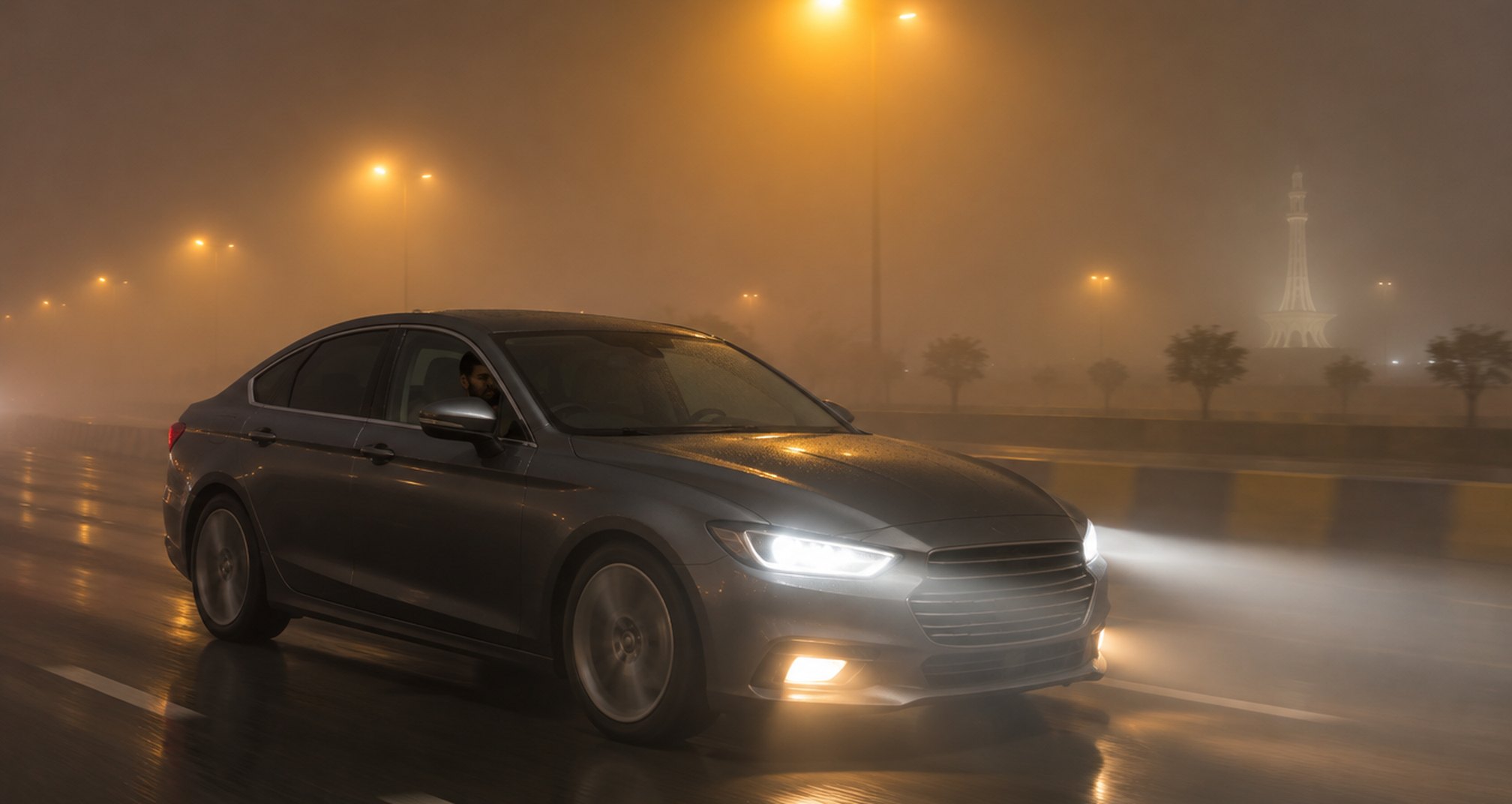
A film that looks smart at 2 PM on MM Alam Road can feel like a blindfold at 11 PM on the Ring Road in December. Window tint night visibility is the part of tinting most owners never think about in October, when they book the job. Then the fog arrives, the rear window turns into a black slab, and reversing out of a dark driveway becomes guesswork. This post covers what tint darkness does after sunset, why fog makes it worse, and how to pick a shade you can live with all year.
How Window Tint Changes Night Visibility
Every tint cuts the light reaching your eyes, and at night your eyes have very little light to spare. In daylight, a dark film takes the edge off glare and you barely notice the loss. After dark, the same film takes away a share of the little light that streetlamps, headlights and reflectors give you. So window tint night visibility comes down to one number on the film box: VLT.
What VLT Numbers Mean on Your Glass
VLT stands for visible light transmission. It is the percentage of visible light that passes through the glass with the film on. A 70% film lets most light through and looks almost clear. Drop to 35% and about a third gets through. A 5% film, the “limo” shade, lets through a twentieth.
There is a catch most buyers miss. Factory glass is rarely fully clear, and many cars come with a light factory shade on the rear glass. Put a 35% film on that and the finished window reads darker than 35%. So ask for the figure on your car, with the film fitted, and not the number printed on the roll.
| Film VLT | How It Looks | At Night From Inside |
|---|---|---|
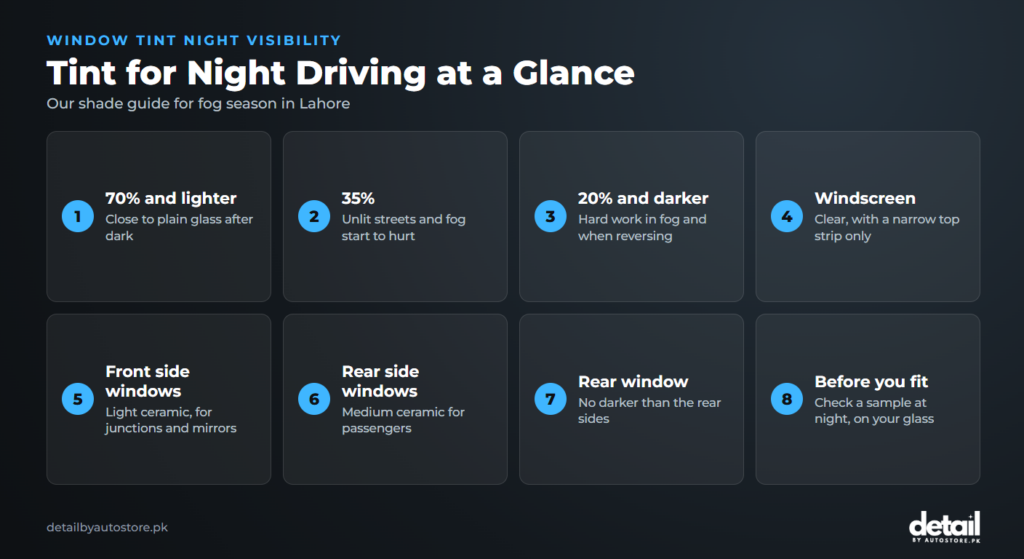
| 70% and lighter | Nearly clear | Close to plain glass for most drivers |
| 50% | Light smoke | Dimmer, still usable on lit roads |
| 35% | Medium, privacy from a distance | Dark unlit streets and fog start to hurt |
| 20% | Dark, hard to see in | Hard work in fog, reversing and at unlit junctions |
| 5% | Near black | Little useful view out once the sun sets |
Why Darker Window Tint Hurts Night Visibility More
Road safety researchers have tested this for decades. One Adelaide study on window tinting and night driving had young and older drivers spot targets through a front side window, clear and tinted. The older group produced 178 of the 179 missed targets, and they reacted more slowly through the tinted glass. The authors argued that front side windows should let through at least 70% of light.
A 1990s American review reached a similar view. It found the effects grew sharper as transmission dropped below 70%, especially for older drivers and people who wear glasses. It also found no clear effect in bright daytime.
Window Tint and Night Visibility in Lahore Fog Season
Fog season in Punjab runs roughly from late November into January, and the smog arrives before it. December 2025 brought repeated motorway closures. On one night in late December, the motorway police shut the M2 from Thokar Niaz Baig to Kot Momin, with visibility on the National Highway between zero and 100 metres. The police advice was blunt: travel between 10 AM and 6 PM.
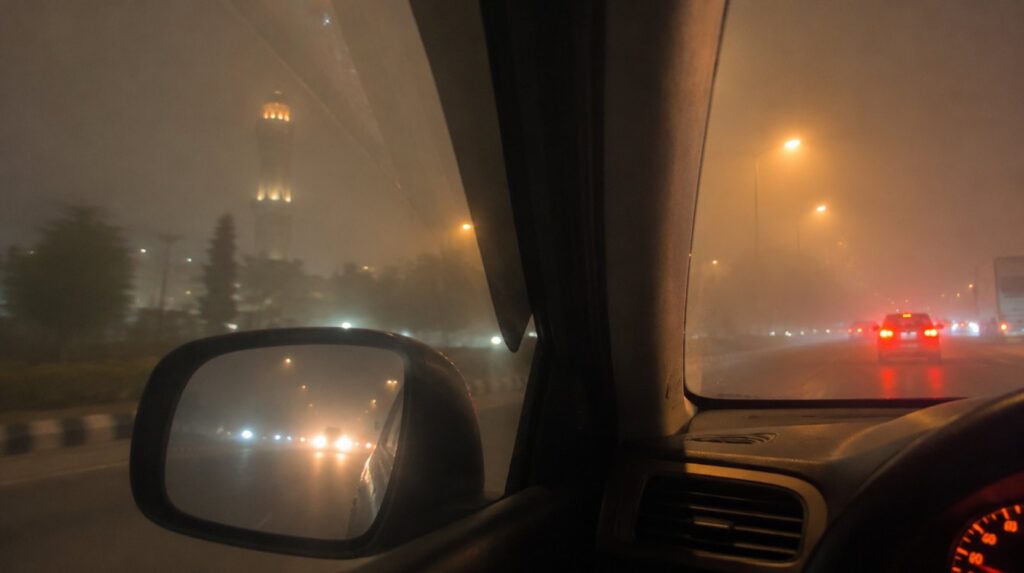
Most of us still drive at night, though. Office runs end after dark, weddings end later, and the Ring Road does not close every time it gets murky. Fog scatters light in every direction, so everything you need to see loses contrast. A grey car in grey fog is already hard to pick out. Put a 20% film between you and it, and you have taken away most of what little contrast was left. That is why window tint night visibility matters most in the weeks when the fog sits low.
The Rear Window and Your Mirrors
Owners usually go darkest at the back, because that is where the family sits. In fog, though, the rear window is how you judge the car behind you. Your interior mirror looks through that glass. With dark film and thick fog, the mirror shows two headlamp blobs and nothing else, so you cannot tell how close they are. Reversing out of a dim parking lot in Gulberg gets harder too. A camera helps, but cameras fog, smear and fail.
Front Side Windows at Junctions
You look through the front side windows at every junction, roundabout and U-turn. That is where motorcyclists without lights, pedestrians in dark shawls and donkey carts appear. On the canal underpasses and the unlit service roads off the Ring Road, those are the targets that matter. A dark front side film makes each one appear later, and later means less time to brake.
Choosing a Window Tint That Protects Night Visibility
Most people tint for two reasons: heat and privacy. Heat is the big one in a Lahore June. Modern films reject heat through what they are made of, so you no longer need a dark film to keep the cabin cool.
Ceramic Film Versus Dyed Film
Cheap dyed film works by darkness alone. To cut more heat, it has to get darker, and night vision pays the price. Ceramic film carries tiny non-metal particles that absorb infrared, the part of sunlight you feel as heat on your arm. Film makers now sell ceramic shades as light as 70% VLT that they rate at around 90% infrared rejection. Those are lab figures on plain glass, so treat them as a guide, but the principle holds: a light ceramic film can feel cooler than a dark dyed one.
Ceramic has two other night-time benefits. Good ceramic film has low reflectivity, so you see fewer reflections of your own dashboard lights on the glass. Also, because it contains no metal, it does not interfere with phone, GPS or Bluetooth signals. UV protection does not depend on shade either. Quality films block around 99% of UV even in the lightest grades.
| Glass | Our Suggestion for Night Driving | Why |
|---|---|---|
| Windscreen | Clear, with only a narrow strip along the top | Your main view; the strip cuts low sun without crossing your sight line |
| Front side windows | Light ceramic | Junctions, side mirrors and lane changes all go through this glass |
| Rear side windows | Medium ceramic | Privacy and heat for passengers, small role in your view |
| Rear window | No darker than the rear sides | Your interior mirror and reversing view depend on it |
Lighter at the Front, Darker Behind
Keep the glass you look through lightest, and put the darker film where passengers sit. That one rule protects your window tint night visibility better than any brand name. If you drive a lot at night, wear glasses or are past 50, go lighter still. Family SUVs have their own trade-offs with big rear glass and third rows, which our guide to window tinting for family SUVs covers. For a broader look at shades, read how to choose the right window tint shade, and for the films with the best UV rejection, see our top five window tints for UV rejection.
Also, clean glass matters as much as the film. Smog leaves an oily haze on windows, inside and out, and that haze turns oncoming headlights into starbursts. Our post on what Lahore smog does to paint and glass explains how to clean it without scratching.
Tint Rules in Pakistan: What Is Settled and What Is Not
We will be careful here, because the rules have moved more than once. Punjab brought in a new motor vehicles ordinance in late November 2025 with heavier penalties, and enforcement on tint was busy that year. In the first ten months of 2025, Punjab traffic police issued around 202,000 tinted-window fines, and Lahore recorded more than 64,000 tint offences on its own.
Since then, reports from Lahore in 2026 say traffic police stopped challaning factory-fitted tint on side and rear glass. Aftermarket film is a different matter, and we have not found a published VLT percentage for Punjab that we can point you to with confidence. At federal level, a revised tinted glass permit policy was still a draft in mid-2026.
Whatever the law ends up saying, dark film on the front still costs you night visibility through the window you use most, so tint choice is a safety call as well as a legal one. So treat any shop that quotes you a “legal percentage” with caution, and check the current position with City Traffic Police Lahore before you fit dark film. Our posts on window tint laws in Pakistan for 2026, window tints and the law and the legal and safety mistakes with 5% tint go into more detail.
What to Ask Before We Fit Your Tint
Bring these questions to any studio, ours included. A good fitter answers each one without hesitating.
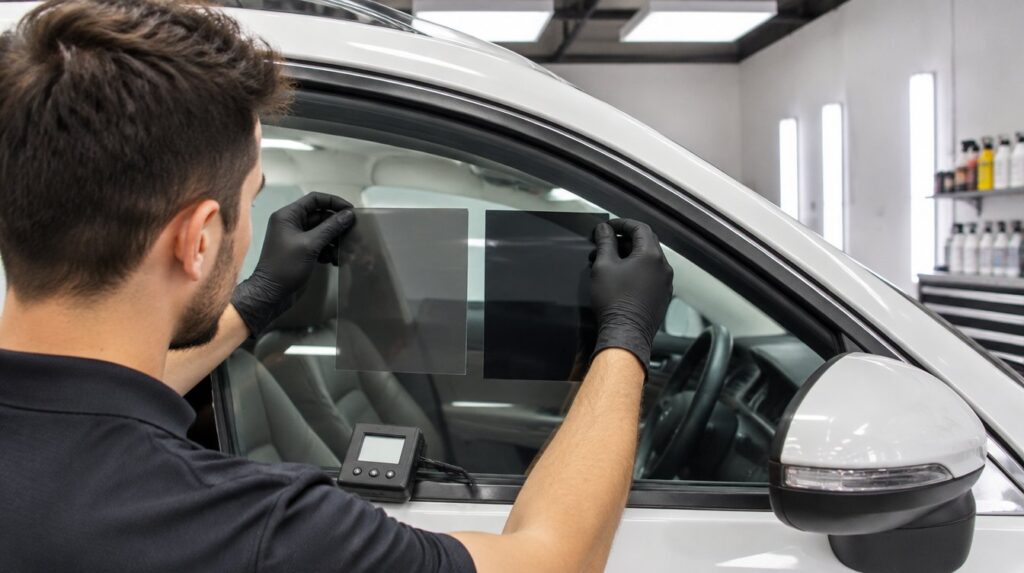
- What is the VLT with the film on my glass? Ask them to measure or show a sample against your window, not quote the roll.
- Is it ceramic, dyed or metallised? Ceramic gives you heat rejection without forcing a dark shade.
- Can I see it at night first? Sit in the car with a sample on the glass in a dim spot. Ten minutes tells you more than any brochure.
- How will the rear window and mirrors look? Check the interior mirror view through the sample.
- What does the warranty cover? Fading, bubbling and peeling should all be on the list.
We fit window films at our Gulberg studio, and you are welcome to ask these questions before you book. See our tint and detailing services for what we offer.
Frequently Asked Questions About Window Tint and Night Visibility
Book a Tint Consultation in Lahore
Is your current film too dark for winter driving? Planning tint before the fog sets in? Then book a consultation at Detail by Autostore.pk. The studio is at 99-B-III Hussain Chowk, MM Alam Road, Gulberg, Lahore. It is open Monday to Saturday from 10 AM to 8 PM and closed on Sunday. WhatsApp 0302 2111 406.